
Psychology in Magic: How Magicians Fool the Mind

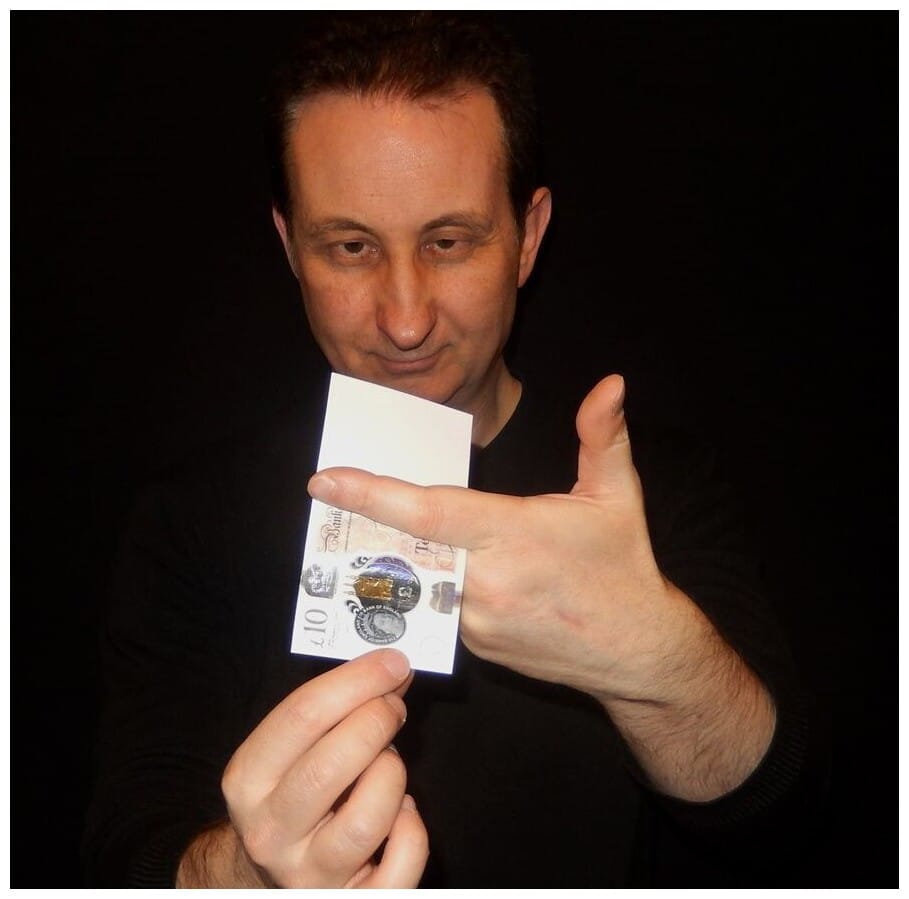
Andy Field is a professional Cheltenham magician, offering close up magic, sleight of hand illusions, mind reading and more, for a variety of occasions. Over the years Andy has built a strong global following,with millions of views on his YouTube channel and an array of reviews across multiple platforms. Having amassed experience as a wedding magician, party magician & close up magician, Andy is seen as one of the busiest professional magicians in the UK.
How magic uses psychology
 How can a magician know what you're thinking? How can they make you choose the card they want? How can they seemingly predict a decision you haven't even made yet? And how can a magician make you absolutely certain that you know what happened — only to discover that you were completely wrong?
The answer is often psychology.
I'm Andy Field, a professional close-up magician with a quarter of a century of experience, specialising in close-up magic, sleight of hand, mind reading and interactive magic.
I've performed at weddings, parties, corporate events, restaurants and private functions, working with everything from playing cards and coins to borrowed rings, phones and everyday objects.
My performances have been seen by more than 20 million people online, I've received hundreds of recommendations, I've been a SAMS Champion of Close-Up Magic, and I've even been consulted by the BBC for Hustle.
So, after a quarter of a century of making people question their own eyesight, memory and occasionally their sanity, I've learned something rather interesting.
The human mind is a magician's best prop.
And the really clever thing is that you bring it with you.
You don't have to put it on the table or charge the batteries.
And, thankfully, nobody has ever asked me to put it back in the box after the performance.
What Does Psychology Have to Do With Magic?
When people think about magic, they often imagine secret techniques.
They picture a magician hiding a card, secretly moving a coin or using some complicated piece of apparatus.
And yes, sleight of hand is an important part of close-up magic.
But magic isn't only about what the magician does.
It's also about what the audience thinks is happening.
That distinction is enormously important.
A magician might perform exactly the same physical action in two completely different ways.
In one version, the audience immediately becomes suspicious.
In the other, they don't notice anything unusual.
The physical movement might be almost identical.
The difference is psychology.
A good magician understands how people naturally:
- Make assumptions
- Follow patterns
- Remember events
- Make choices
- Respond to suggestion
- Focus their attention
- Follow eye contact
- Interpret body language
- React to confidence
- Look for meaning
- Fill in missing information
None of this means that spectators are gullible.
Far from it.
These are normal human behaviours that help us navigate everyday life.
The magician simply builds a performance around them.
The Human Brain Is Always Making Predictions

A group watches a magician perform a card trick, illustrating how the human brain makes predictions and how magicians use psychology to influence expectations.
Your brain doesn't passively sit there waiting for information.
It's constantly trying to predict what is going to happen next.
If I drop a ball, you expect it to fall.
If I place a coin in my hand and close my fingers, you expect the coin to still be there.
These expectations are perfectly sensible.
In everyday life, they're extremely useful.
In magic, they can be exploited.
A magician can create a situation where your brain makes a perfectly reasonable assumption — and then use that assumption to create an impossible result.
That's one of the foundations of psychological magic.
The magician doesn't necessarily have to force you to believe something.
They simply allow your brain to reach the conclusion they want.
And your brain is usually very helpful.
Thank you very much.
Why Expectations Are So Important in Magic
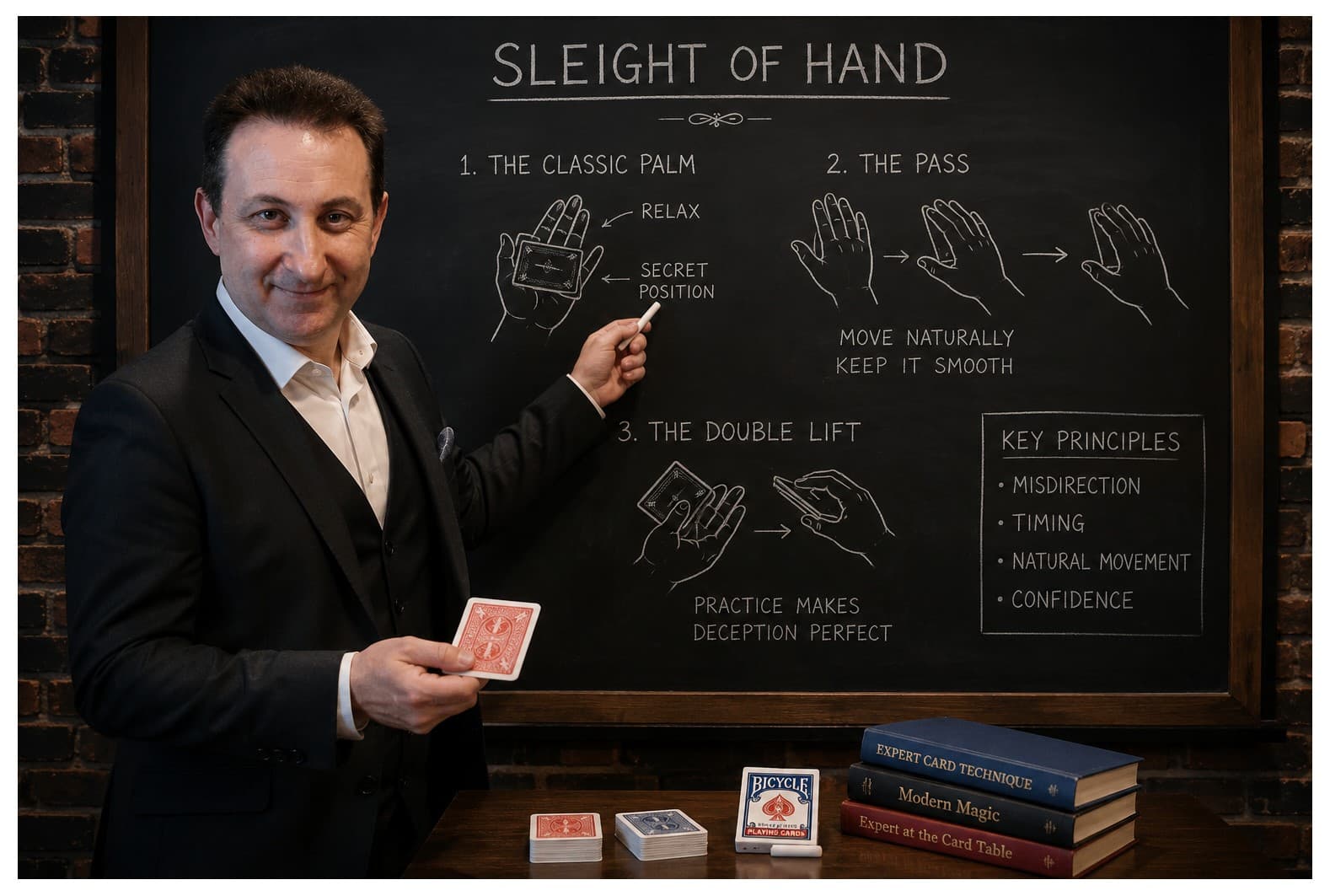
Magician Andy Field explains sleight of hand and how audience expectations influence the way people perceive and experience magic.
Imagine I place a coin on the table.
You see it.
I pick it up.
You see me hold it.
I close my hand.
You naturally believe the coin is inside my hand.
Why wouldn't you?
There's no reason to suspect otherwise.
The conditions matter too. When objects remain visibly separate, the audience has fewer obvious explanations for how one could have influenced the other. This is one of the ideas behind the no contact rule in magic.
Now imagine the coin disappears.
The interesting thing is that your brain doesn't simply say:
“The coin disappeared.”
It starts trying to work backwards.
It asks:
Where did it go?
When did it leave?
Did I see it move?
Was it really in his hand?
Did he distract me?
Was there another coin?
Your brain is trying to solve the puzzle.
And that's exactly what the magician wants.
The more your mind tries to explain what happened, the more entertaining the mystery becomes.
Psychology and Misdirection
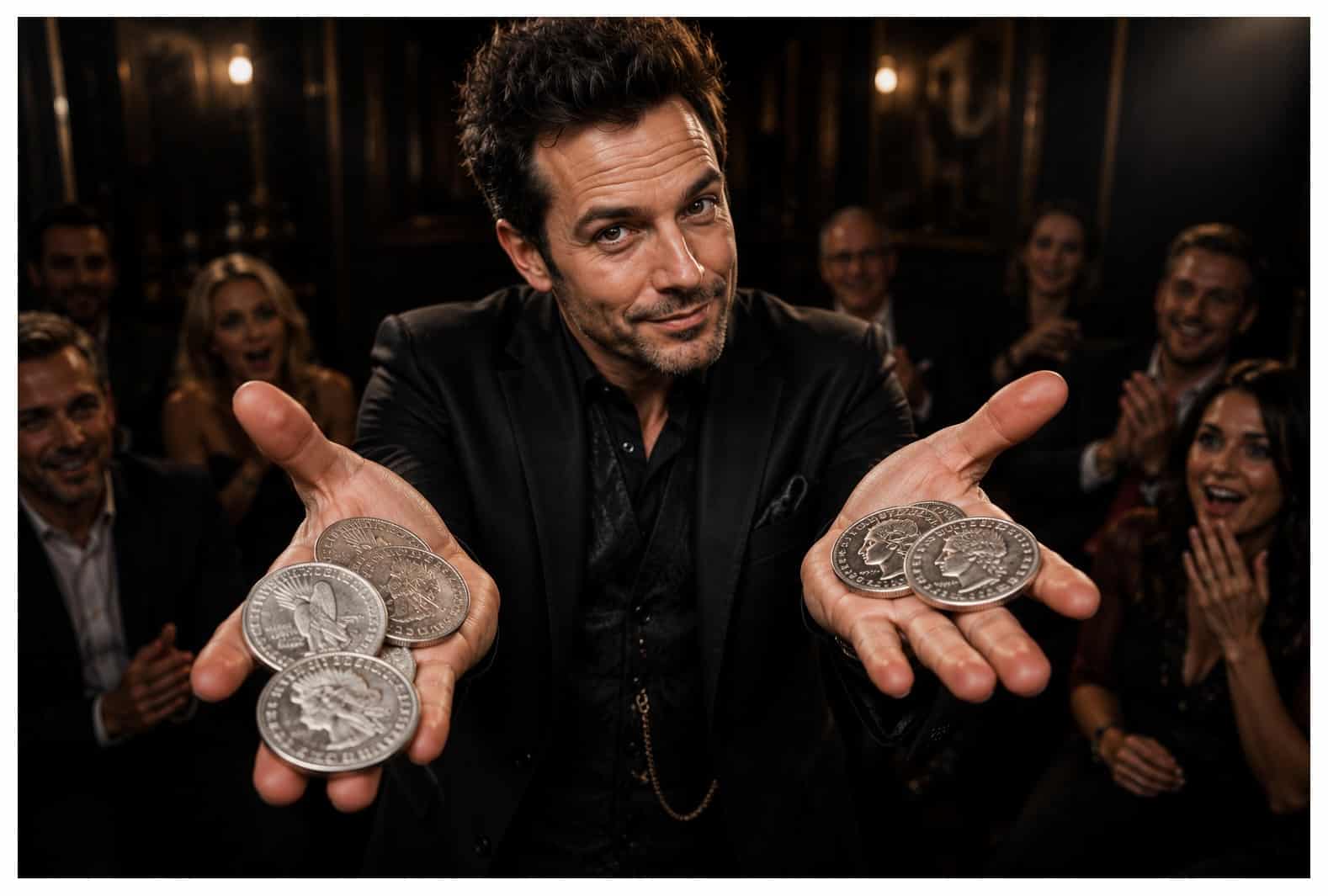
A professional magician performing close-up coin magic and sleight of hand with silver coins, demonstrating how psychology and technique combine to create an entertaining magical experience.
Psychology and misdirection are closely connected.
Misdirection isn't necessarily about making you look away.
It's about controlling what you consider important.
Suppose I'm performing a coin trick.
You might be staring directly at my hands.
But if I ask you a question at precisely the right moment, your attention may shift from the mechanics of what I'm doing to the conversation.
You might answer.
You might look at me. Even better you might laugh. Maybe even think about the question.
The secret action may happen during that completely ordinary interaction. You haven't been forced to look away.
Your brain simply decided something else was more important.
That's psychology.
And that's much more subtle than waving a hand in front of your face and shouting:
“LOOK AT THAT!”
Although, admittedly, that does occasionally have its uses.
The Psychology of Attention
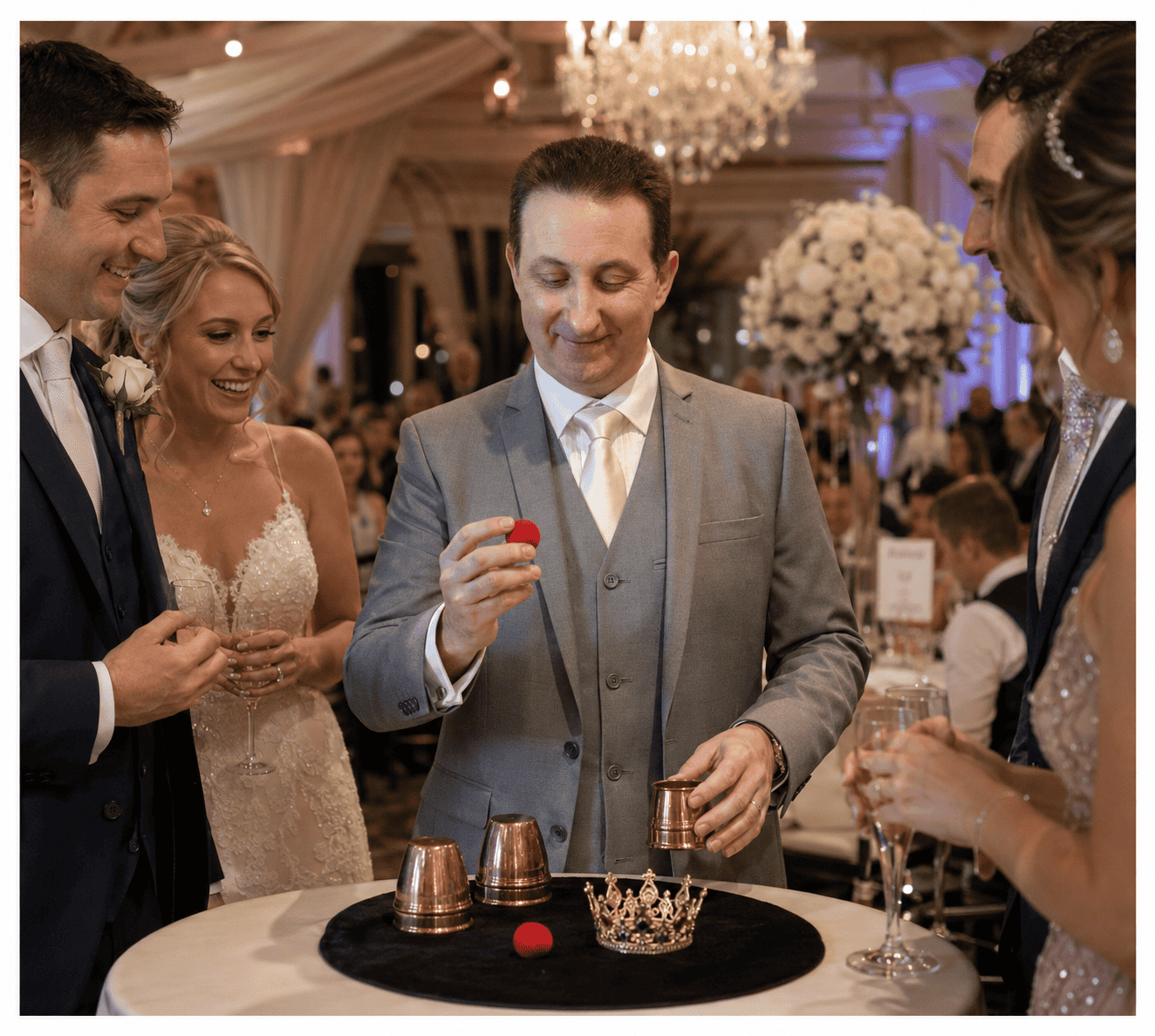
Professional magician Andy Field performing the Cups and Balls, demonstrating how magicians use attention, misdirection and audience psychology to create an impossible magical experience.
Human attention is limited.
We cannot consciously process everything around us with equal intensity.
When you're watching a magician, you might think you're paying attention to everything.
You're not.
Nobody is.
You're selecting.
You may concentrate on:
- The magician's hands
- A playing card
- A coin
- A spectator
- The magician's face
- What the magician is saying
- What you're expecting to happen
And when you concentrate on one thing, other information becomes less important.
This is where psychological misdirection becomes powerful.
The magician can create a hierarchy of attention.
This is important.
That isn't.
Watch this.
Ignore that.
The magician doesn't have to say those things directly.
The structure of the routine can communicate them.
The Cups and Balls is a classic example of how attention, expectation and misdirection can work together to create an impossible magical experience.
Why Eye Contact Works

A magician making direct eye contact with a spectator, demonstrating how eye contact can influence attention and help magicians guide an audience's focus during a performance.
Eye contact is one of the simplest psychological tools available to a magician.
If I look directly at you, there's a good chance you'll look at me.
It's a normal social response.
If I'm talking to you, looking at you is polite.
Or if suddenly look at something else, you may follow my gaze.
Magicians can use this without the audience consciously noticing.
Imagine I'm holding a coin.
I look at the coin.
You look at the coin. Then I look at you. You look at me. For a tiny moment, your attention has changed.
That's potentially all that's required. Good magic can be built around very small psychological moments.
The magician doesn't need to control your attention like a remote control.
They only need to influence it.
The Psychology of Choice
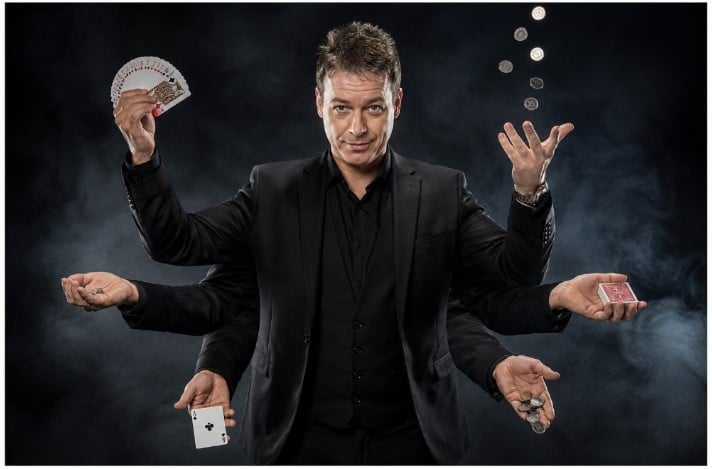
A magician offering a spectator multiple choices during a magic performance, illustrating how magicians can use the psychology of choice, suggestion and free will to influence an audience's decisions.
One of the most fascinating areas of magic is apparently free choice.
A magician might spread a deck of cards and say:
“Choose any card.”
That sounds completely fair.
You could choose any card.
You might even point out afterwards:
“You told me I could choose any card.”
And I did.
But there's a fascinating question hiding underneath that sentence.
What does “free choice” actually mean?
Magicians have developed countless methods for influencing, controlling or predicting choices.
The method could be mathematical, physical, psychological or combinations.
The audience may feel that they made an entirely free decision.
And that feeling of freedom is crucial.
If you believe you had a choice, the eventual revelation becomes much stronger.
Suggestion in Magic
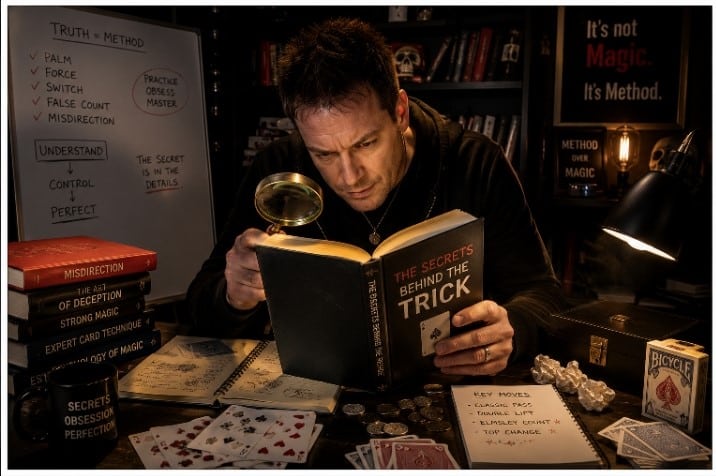
A magician reading a book, illustrating how suggestion, language and psychological influence can shape the way an audience thinks and experiences a magic performance.
Suggestion can be surprisingly powerful.
A magician may use words, tone of voice, gestures or context to subtly influence what an audience notices or chooses.
That doesn't mean the magician has magical control over your mind.
If I say:
“Think of a colour.”
you can choose one.
I don't automatically know it.
But the way the question is asked, the context surrounding it and what happens afterwards can all influence your thinking.
Mentalism and mind reading performances often make particularly strong use of suggestion.
The magician creates a situation in which the audience begins thinking along a particular path.
And sometimes the audience doesn't even realise that the path has been created for them.
Priming and Magic
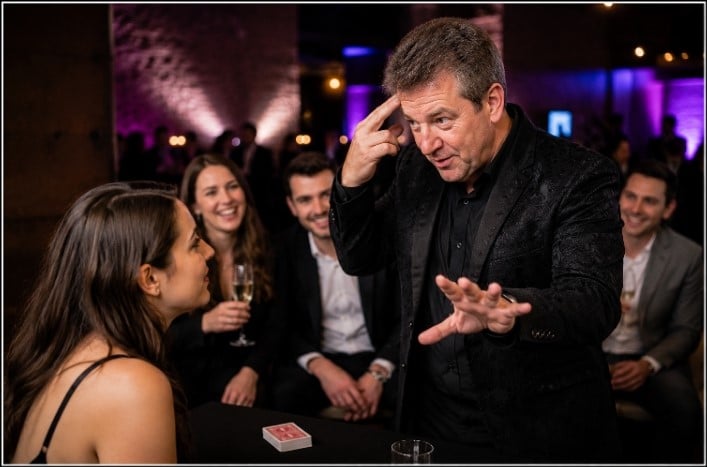
A magician appearing to read a spectator's mind, illustrating how priming, suggestion and psychological techniques can influence thoughts and choices during a magic performance.
Priming is another psychological concept that can be useful in magic.
The basic idea is that previous information can influence how you respond to something that comes later.
For example, if I spend time talking about certain objects, colours or ideas before asking you to make a choice, that earlier conversation can affect what comes to mind.
A magician can incorporate this into a routine.
The audience believes the choice came out of nowhere.
But the magician has carefully constructed everything that came before it.
This is one of the reasons professional magic routines are often carefully scripted.
The apparently casual conversation may not be as casual as it appears.
The Psychology of Language

A professional magician performing a coin trick, illustrating how language, communication and psychological techniques can influence attention and perception during a magic performance.
Words are incredibly useful in magic.
Consider the difference between:
“Take a card.”
and:
“Take any card you like.”
The second sounds considerably freer.
The language affects your perception of the choice.
Magicians can also use words to establish expectations.
If I tell you something is going to happen while you're looking at your hand, you'll probably concentrate on your hand.
If I tell you that something has already happened, you may start looking backwards through the sequence.
Language directs thought.
And thought directs attention.
The Power of Confidence
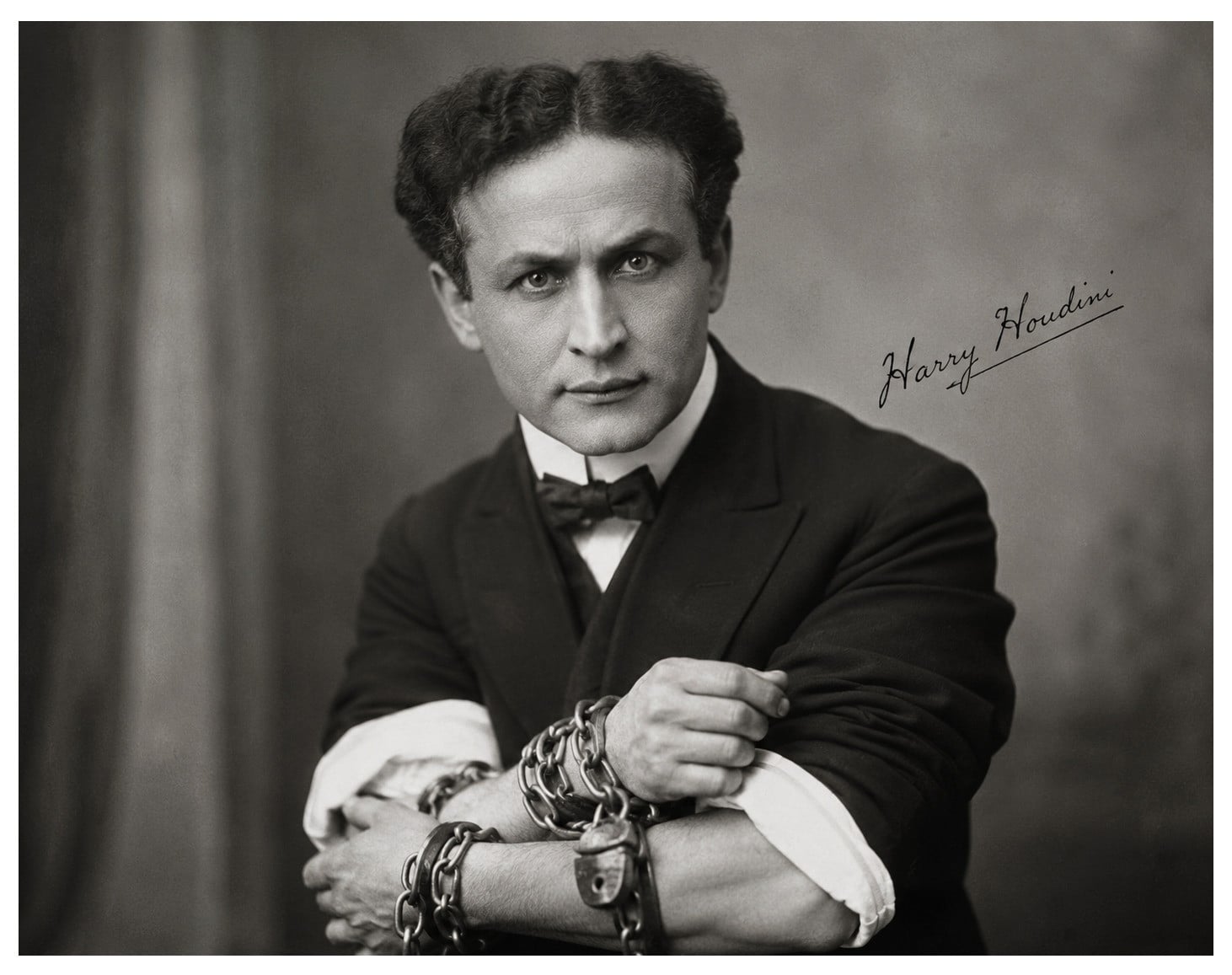
A historic photograph of Harry Houdini, illustrating how confidence, presence and performance can influence an audience's perception of a magician.
Confidence is another important psychological element.
Imagine two people performing the same trick.
The first magician looks nervous.
They hesitate.
They constantly check their hands.
They look like they're worried something might go wrong.
The second magician looks relaxed.
They speak naturally.
They smile. They make eye contact. They don't appear to be hiding anything. Who would you trust? Probably the second person. And that's why confidence matters.
A magician who behaves naturally makes the audience feel that everything is under control.
The audience doesn't necessarily start looking for a secret.
They simply enjoy the performance.
Why Nervous Behaviour Can Give a Magician Away

A magician entertaining and wowing a crowd during a live performance, illustrating the importance of confidence, natural behaviour and audience connection in professional magic.
The opposite is also true.
If a magician behaves strangely, spectators become suspicious.
Suppose I perform a card trick and suddenly become very quiet every time I touch the deck.
You'd notice.
If I keep looking at my pocket, you'd notice.
If I make an awkward movement and then immediately start talking about something else, you'd probably notice that too.
Good psychological magic therefore isn't simply about manipulating the audience.
It's about not giving them reasons to become suspicious. Natural behaviour is important.
The Psychology of Familiarity

A magician performing for a group of spectators, illustrating how familiar actions and repeated patterns can influence audience expectations and perception during a magic performance.
People become less suspicious of actions they've already seen.
Suppose I repeatedly pick up a deck of cards in exactly the same way.
After a while, that movement becomes familiar.
Your brain doesn't need to analyse it every time.
That's useful to the magician.
A secret action can sometimes be hidden inside a familiar action.
The audience sees something they recognise.
Their brain effectively says:
“I've seen that before.” And moves on. This is why routines are so carefully structured.
The magician can establish patterns before breaking them.
Repetition and the Surprise
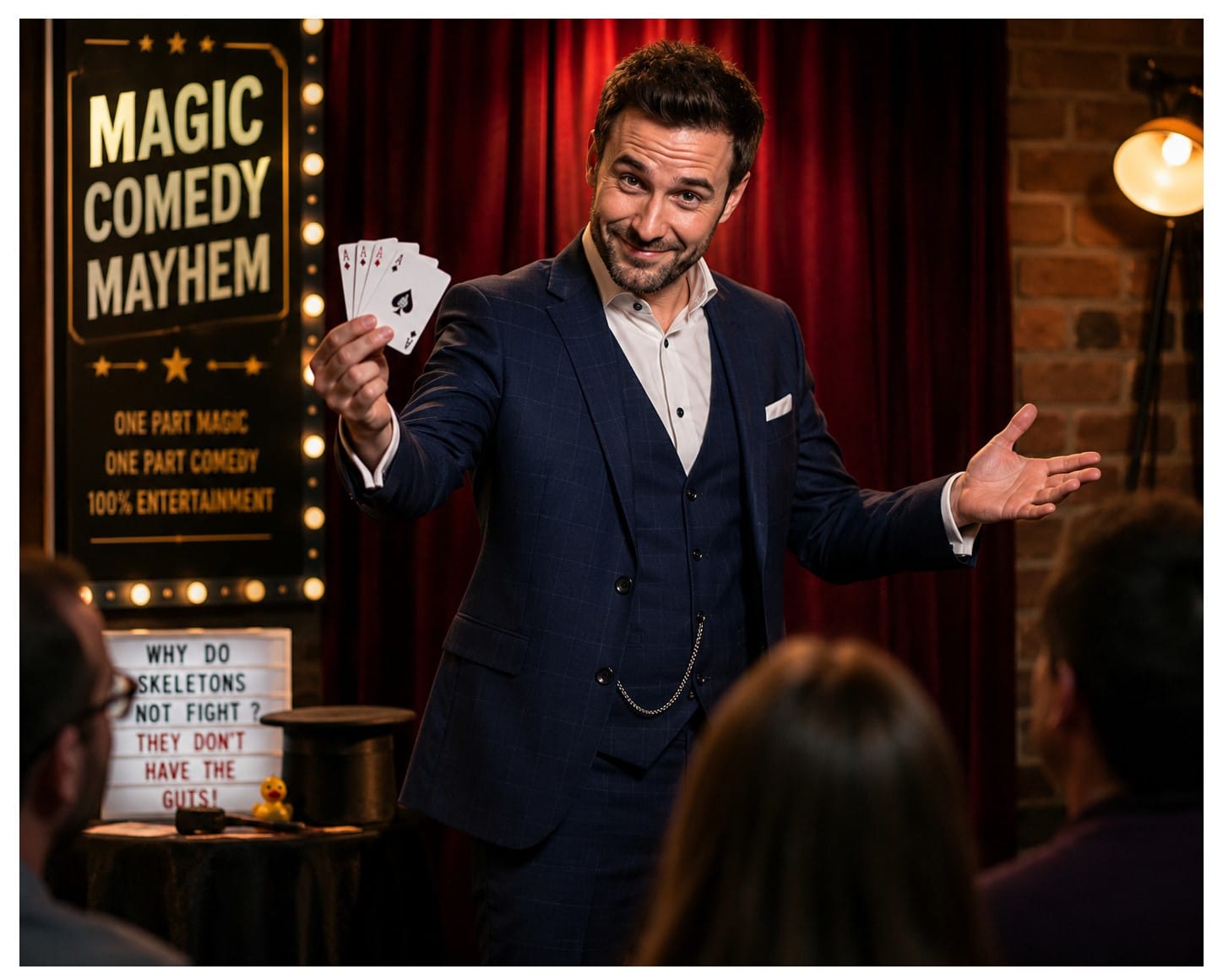
A magician performing a comedy card trick, demonstrating how repetition builds audience expectations before an unexpected result creates surprise and laughter during a magic performance.
Repetition can also create a very strong magical moment.
If I do something three times in exactly the same way, you begin to understand the pattern.
Then I do it a fourth time.
You expect the same result.
But something different happens.
The psychological impact can be enormous.
Your brain predicted one outcome.
Reality delivered another.
And that gap between expectation and reality is where much of the feeling of magic comes from.
The Psychology of Memory

Two women practising card counting with playing cards, illustrating how concentration, memory, observation and psychological processes can play a role in magic and mentalism
Memory is another fascinating part of magic.
Most people assume memory works like a recording.
It doesn't.
We don't simply store a perfect video of everything that happens.
Memory is reconstructive.
We remember important moments, impressions, emotions and sequences.
And when something unusual happens, our brain tries to make sense of the experience.
Magicians can take advantage of this.
The audience might remember a card being shuffled.
They might remember holding the deck. They might remember the magician never touching the card. But the precise details of what happened can be surprisingly difficult to reconstruct. That's why people often argue about magic afterwards.
One person says:
“He never touched the deck.”
Someone else says:
“Yes, he did.”
And the magician is standing there thinking:
“Excellent.”
Why Magic Feels Impossible

Two women performing magic tricks that fool a group of men, illustrating how perception, expectations and psychological misdirection can make a magical experience seem impossible.
A magical experience becomes particularly strong when your explanation system fails.
Normally, if something unusual happens, you find an explanation.
If you can't find your keys, you assume you misplaced them.
If a card changes, however, the normal explanations don't seem to work.
Your brain starts searching.
But the magician has constructed the routine so that the obvious explanations have been removed.
That's what makes the effect feel impossible.
The Psychology of Suspicion

A woman performing magic for a group of men, illustrating how suspicion, observation and audience attention can influence the way spectators experience and try to understand a magic trick.
Interestingly, magicians don't necessarily want you to suspect nothing.
A little suspicion can actually make magic stronger.
If you think:
“He must have done something.”
you start looking.
Then you don't find anything.
That can be more powerful than never suspecting a secret at all.
The audience becomes part of the investigation.
They watch closely. They analyse. And the magician fools them again. That's a wonderful psychological game.
Why Magicians Ask Questions

A magician asking a spectator a question during a magic trick, illustrating how questions, interaction and conversation can influence attention, decisions and audience participation.
Questions are incredibly useful during magic.
If I ask you:
“What's your name?”
you answer.
Your attention moves into conversation.
If I ask:
“Which hand would you like?”
you make a decision.
If I ask:
“Are you sure?” you reconsider. Questions create interaction. They also change the rhythm of the performance. Instead of simply watching a magician perform, you're now participating.
And participation can make an effect feel much more impossible.
Because if you made the choice, how could the magician possibly have known?
That's the psychological hook.
The Psychology of Participation

A magician involving spectators in an interactive magic trick, illustrating how participation, audience interaction and personal involvement can make a magical experience more memorable and impossible to explain.
People generally remember experiences they participated in more strongly than things they simply watched.
That understanding has become particularly important over the years because I've performed at a huge variety of events, venues and towns across the South West.
This is one reason close-up magic is so effective at weddings, parties and corporate events, particularly when you're looking for a professional magician in Bristol.
You aren't sitting passively in a theatre.
You aren't sitting passively in a theatre.
You may be holding the cards or lend the magician your ring.
You may shuffle the deck and make a decision.
You may be the person who experiences the impossible result.
That personal involvement is one of the reasons a magician can add real value to an event, rather than simply filling a gap in the schedule.
That makes the magic personal.
And when the object belongs to you, there is an additional psychological layer.
You know it was real. It's your ring. Your signed card.
That makes the mystery considerably harder to dismiss.
If you're considering booking a magician for an event, my guide to hiring a magician explains what to look for, when magic works best during an event and how to choose the right style of magician for your occasion.
Why Borrowed Objects Are So Strong

A woman holding three playing cards during a magic trick, illustrating how familiar and everyday objects can be used to create an engaging and memorable magic experience.
A magician carrying a strange prop can always be accused of preparing it.
A borrowed object is different.
If I borrow your ring, I didn't have it before the trick.
If I borrow a £10 note, you know where it came from.
The psychology is simple:
The more impossible it is to explain the object, the stronger the effect becomes.
That's why I particularly enjoy using everyday objects.
You don't need a giant box.
Sometimes all you need is something somebody happens to have in their pocket.
And perhaps a magician who knows what he's doing.
And when the object belongs to you, there is an additional psychological layer, which is one reason close-up magic works so well at weddings and events in Bristol.
You may be holding the cards or lending the magician your ring, experiencing the magic at close quarters and seeing the impossible happen with objects in your own hands.
Psychology and Sleight of Hand

A woman performing a card trick using sleight of hand, illustrating how psychological techniques and physical skill work together to create convincing and entertaining magic.
Psychology doesn't replace sleight of hand.
The two work together.
A magician may need the physical skill to secretly move an object.
Psychology helps determine when that movement happens, where the audience's attention is and what they expect.
You can learn more about the physical side of magic in my guide to Sleight of Hand Explained.
And if you're interested in the broader world of close-up magic, my Close-Up Magic Explained guide looks at how different techniques and approaches come together.
The important thing to remember is that a secret technique on its own isn't necessarily entertaining.
Magic happens when technique, psychology and presentation combine.
If you're particularly interested in card magic, I've also written a detailed guide to Card Trick Magician Bath, covering card sleight of hand, psychology, misdirection, card predictions and the different ways card magic can be used at weddings, parties and events.
Psychology and Misdirection

Two women magicians performing a magic trick for a group of men, illustrating how misdirection, attention and psychological techniques can influence what spectators notice and how they interpret a magical performance.
Misdirection is probably one of the clearest examples of psychology being used in magic.
A magician can influence attention through:
- Eye contact
- Speech
- Movement
- Timing
- Questions
- Expectations
- Body position
- Emotional reactions
- Familiar patterns
- Surprise
And the best part?
You don't necessarily notice any of it.
You simply experience the magic.
That is why excellent misdirection feels effortless.
It doesn't feel like somebody is manipulating you.
It feels like you're simply watching something happen.
Can Magicians Really Read Minds?
 This is where psychology becomes particularly interesting.
Professional mentalism and mind reading performances can look incredibly convincing.
But that doesn't mean the magician has supernatural powers.
Instead, mentalists can combine techniques such as:
- Psychological principles
- Observation
- Suggestion
- Misdirection
- Memory
- Verbal techniques
- Prediction
- Sleight of hand
- Structured choices
- Audience management
The result can look like genuine mind reading.
And because the spectator is actively thinking, the experience can feel deeply personal.
That's one reason mentalism can be so powerful.
Reading Body Language
A woman holding a large amount of money, illustrating how body language, facial expressions and nonverbal signals can provide useful information during magic and mentalism performances.
Magicians and mentalists can also pay attention to physical behaviour.
A person's facial expression may change.
They might hesitate or move their eyes.
They might change their posture.
They might react differently to one suggestion than another.
None of these signals are guaranteed to reveal someone's thoughts.
Human behaviour is far too complicated for that.
But they can provide information.
An experienced performer learns to watch.
Not just the cards.
Not just the coins.
The people.
That's often where the real information is.
The Psychology of the Impossible Choice

A woman performing a magic trick, illustrating how choice, free will, suggestion and psychological techniques can make a spectator's decision appear impossible to predict.
One of my favourite things about magic is the apparently impossible choice.
I'll ask someone to choose something.
They choose.
They could have chosen something else.
That's important.
Because if I simply tell you what to choose, the magic is less impressive.
But if you genuinely feel that you could have chosen anything, the eventual revelation becomes much stronger.
This is why magicians spend so much time thinking about the structure of choices.
It's not enough to know where the trick ends.
You have to know how the audience gets there.
Why the Beginning of a Trick Matters

A magician preparing to begin a performance, illustrating how the opening moments of a magic trick can establish expectations, capture attention and shape the audience's experience.
A common mistake is to think the magic begins when the magician says:
“Watch this.”
Actually, the psychology can begin long before that.
The magician's introduction can establish expectations.
The first action can establish a pattern.
The objects can create assumptions.
By the time the apparent miracle happens, the audience may already have been guided through a psychological journey.
That's why professional magic isn't simply a collection of tricks.
It's carefully constructed entertainment.
Psychology Can Make Simple Magic Stronger

A magician performing a magic trick, illustrating how psychology, presentation and sleight of hand can work together to create a stronger and more memorable magical experience.
You don't necessarily need a complicated trick to create a powerful experience.
Sometimes a very simple method can produce an enormous reaction if the psychological construction is right.
Conversely, a technically difficult trick can fall flat if the presentation is poor.
That's an important lesson for any magician.
Complexity isn't the same as impossibility.
A simple method with perfect timing can be far more deceptive than an incredibly complicated method performed badly.
Why Magicians Don't Always Want You to Watch Their Hands
Two women watching a magician while looking away from his hands, illustrating how attention, misdirection and audience focus can influence what spectators notice during a magic performance.
People often say:
“I'll watch the magician's hands.”
That's understandable.
But magic isn't necessarily about hiding the hands.
In fact, if the magician is good enough, they may be perfectly happy for you to watch.
The trick is that you're interpreting what you're seeing incorrectly.
The hands can be completely visible yet secret can still be invisible.
That's one of the most beautiful ideas in sleight of hand.
The Psychology of Relaxation

Two women relaxing and enjoying a magic performance, illustrating how a relaxed audience can be more receptive to entertainment, interaction and psychological misdirection.
If an audience is relaxed, they're generally more receptive to entertainment.
If they're suspicious and tense, they'll analyse everything.
A good magician therefore wants the performance to feel natural.
Humour helps.
Conversation helps.
Eye contact helps.
Confidence helps.
A laugh at the right moment can completely change the atmosphere.
And that's another reason I like using humour when I perform.
If you're laughing, you're not sitting there looking like you're auditing my fingers.
Although there is always one person who manages to do both.
Usually the accountant.
I don't know why.
Maybe they're checking the figures.
Why Humour Works in Magic
Two women enjoying a humorous moment during a magic performance, illustrating how humour can create connection, relax an audience and make a magical experience more entertaining and memorable.
Humour isn't just there to make people laugh.
It can also affect the psychology of the performance.
A joke changes the audience's emotional state.
It relaxes people.
It creates connection.
And when people enjoy being around you, they're more likely to engage with the performance.
The best humour in magic shouldn't feel like a separate comedy routine.
It should feel like part of the personality of the magician.
That's why I prefer to use natural humour rather than simply telling jokes every thirty seconds.
Although if anybody would like a joke about sodium, I'm afraid I'm afraid of Na.
I'll get my coat.
The Magician as a Performer

A magician performing an interactive magic trick for two women, illustrating how presentation, personality, audience connection and performance skills are essential parts of creating memorable magic.
Psychology is ultimately about people.
You can perform flawless sleight of hand.
You can know every principle of misdirection.
But if you can't connect with an audience, the magic won't have the same impact.
A magician is a performer.
That means understanding people.
Reading the room.
Knowing when to speed up.
Knowing when to slow down. And knowing when to stop. That last one is important.
Sometimes the best trick is knowing when you've done enough tricks.
A magician is a performer. That means understanding people, reading the room and knowing when to speed up or slow down — skills that are just as important when performing close-up magic at an event in Gloucester.
What Makes Psychological Magic So Powerful?

A magician performing an engaging psychological magic trick, illustrating how perception, attention, expectation and audience participation can combine to create a powerful and memorable magical experience.
Psychological magic is powerful because it doesn't just challenge the eyes.
It challenges the mind.
After a good trick, you might think:
“I didn't see the move.”
After a strong psychological effect, you might think:
“But I made that decision.”
That's a completely different feeling.
You aren't simply trying to work out where the object went.
You're questioning your own choices. Your own memory. Your own perception.
And possibly your own brain. Don't worry. Your brain is probably fine.
It's just having a bad evening.
The Audience and the Magician Are Working Together
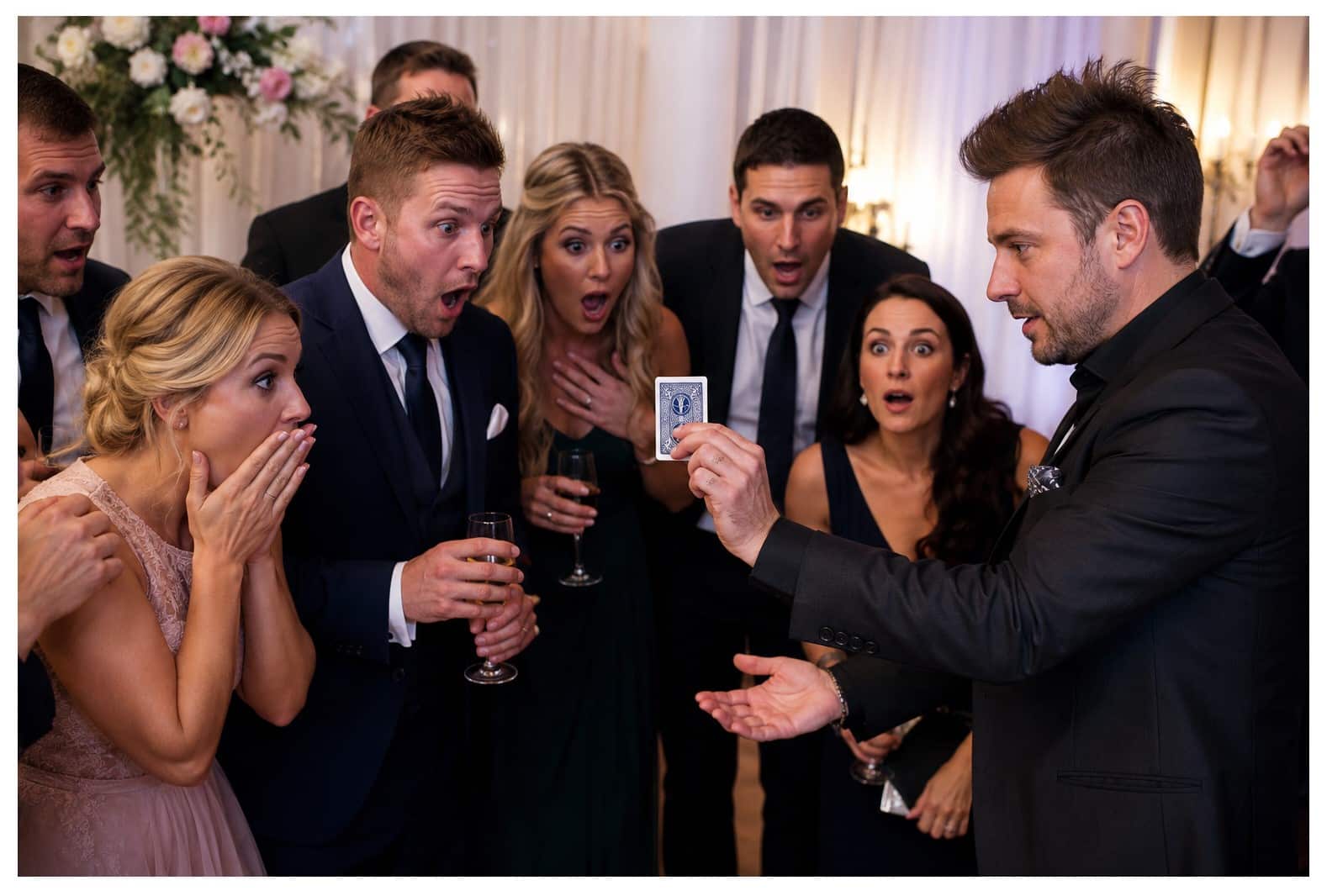
A magician amazing an audience during a live performance, illustrating the impact of presentation, psychology, misdirection and audience interaction in creating a memorable magical experience.
The secret to great magic isn't necessarily the magician defeating the audience.
It's the magician and audience creating an experience together.
The spectator provides:
- Attention
- Decisions
- Reactions
- Emotions
- Expectations
- Personal objects
- Memories
The magician provides:
- Technique
- Presentation
- Psychology
- Timing
- Misdirection
- Storytelling
Put them together and you have magic.
That's why live magic is so different from watching a trick on a screen.
When you're there, you become part of the method of the experience.
Frequently Asked Questions About Psychology in Magic
How is psychology used in magic?
Psychology can be used to influence attention, expectation, choice, memory and perception. Magicians combine these principles with sleight of hand, presentation and timing to create effects that appear impossible.
Do magicians control people's minds?
No. Professional magic doesn't require supernatural mind control.
Magicians can influence perception and sometimes choices using psychological principles, but that isn't the same as having complete control over somebody's thoughts.
Can a magician really predict what someone will choose?
Sometimes a magician can apparently predict a free choice using a combination of psychological principles, mathematical methods, physical techniques, verbal strategies or clever prediction methods.
The audience experiences the choice as free, which is what makes the revelation so powerful.
Does psychology make sleight of hand easier?
Psychology doesn't make the physical technique easier, but it can make the technique more deceptive.
The magician needs both the ability to perform the secret action and the ability to present it naturally.
What is psychological misdirection?
Psychological misdirection is the use of attention, expectation, language, behaviour and timing to influence what an audience notices and how they interpret what they see.
Is mind reading real?
Stage and close-up mind reading performances are forms of entertainment rather than proof of supernatural abilities.
Mentalists can use psychological techniques, observation, suggestion, memory principles, misdirection and other methods to create remarkably convincing demonstrations.
Why do people get fooled by magicians?
People aren't fooled because they're stupid.
They're fooled because the magician constructs the experience around normal human behaviour.
We naturally make predictions, follow patterns, focus our attention, trust familiar actions and reconstruct memories.
A good magician understands those processes and uses them to create an impossible experience.
Why does close-up magic feel more impossible?
Close-up magic happens at very close range and often involves objects belonging to the spectators themselves.
You may hold the cards, choose the object, shuffle the deck or lend the magician your ring.
Because you participate directly, the experience can feel much harder to explain.
Final Thoughts
After a quarter of a century performing magic, I've become increasingly fascinated by the part of magic that isn't actually in the magician's hands.
It's in the audience's head.
A playing card is only a playing card.
A coin is only a coin.
A borrowed ring is only a ring.
The real magic happens when the audience's brain tries to explain what it's seeing and discovers that none of the normal explanations seem to work.
That's what psychology brings to magic.
It helps the magician understand how people see, think, remember, choose and interpret the world around them.
And once you understand that, you realise that the most important part of a magic trick isn't necessarily the secret.
It's the experience.
The magician isn't simply trying to hide something.
They're trying to make you believe something impossible has happened.
And if they do it properly, you'll walk away still thinking about it hours later.
You'll replay the trick.
You'll discuss it with your friends.
And then you'll remember that you were the one holding the card.
That's when you know the magician has done their job.
The best magic doesn't just fool your eyes.
It makes your own mind become part of the mystery.
About Andy Field
 Andy Field is a professional close-up magician specialising in close-up magic, sleight of hand, mind reading and interactive magic for weddings, parties, corporate events, restaurants and private functions.
With a quarter of a century of experience, Andy has performed throughout the UK, creating interactive magical experiences using playing cards, coins, borrowed objects and everyday items.
His performances have received more than 20 million online views, alongside hundreds of recommendations from people who have experienced his magic at events.
Andy has also been a SAMS Champion of Close-Up Magic and has been consulted by the BBC for Hustle.
You can learn more about Andy's background, experience and work as a professional magician on the About Andy Field
If you're looking for a magician who combines close-up magic, sleight of hand, psychology, humour and audience interaction, Andy Field can bring something genuinely memorable to your next event.
Andy Field Magician Service Areas
I regularly provide professional close-up magic for weddings, parties, corporate events and special occasions across the South West and surrounding areas. You can find more information about my magician services in the following locations:
- Bristol Magician
- Gloucester Magician
- Cheltenham Magician
- Swindon Magician
- Somerset Magician
- Magician Oxford
- Magician Bath
- Magician Cotswolds
Explore More About Close Up and Magic
Book Magician Andy Field
I'm fortunate that I don't have to rely on magic to pay the bills. This means I don't need to charge inflated Saturday-night fees. I can concentrate on what I really enjoy — performing powerful, entertaining magic — while keeping my prices competitive.


